Values on Paper vs Culture in Practice
What McKinsey 7S and Theory U taught me about making values real
Before we go any further, it helps to start with a simple question.
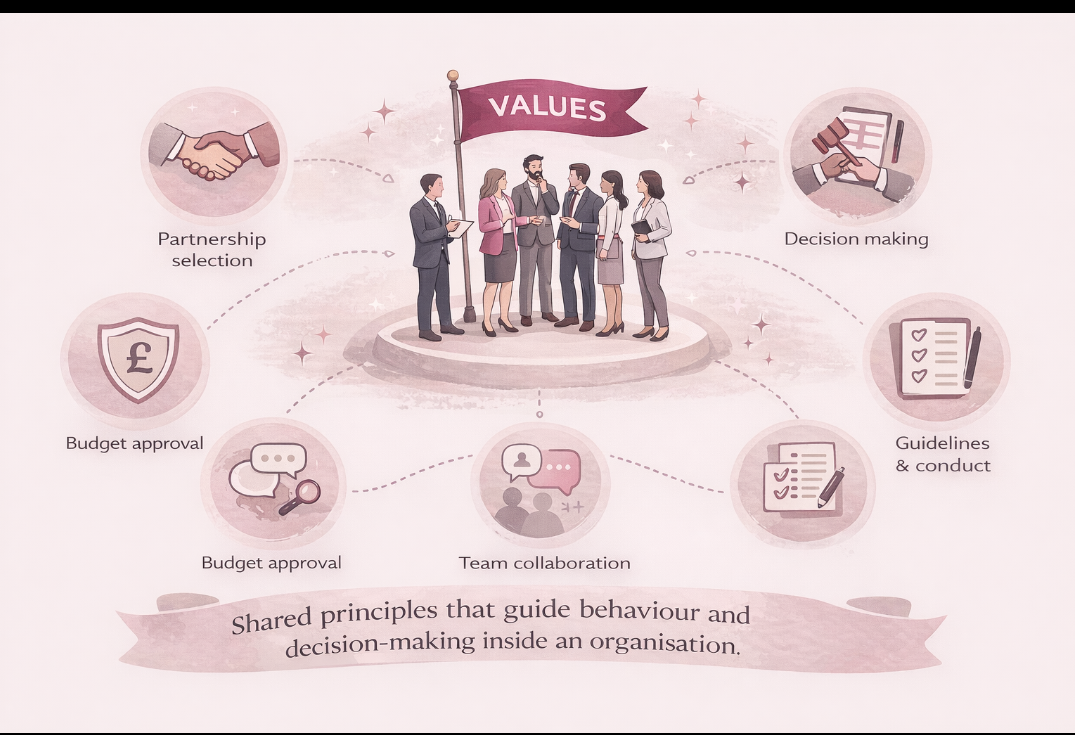
What actually are values?
A useful definition is this:
Values are the shared principles that guide behaviour and decision-making inside an organisation.
They help people understand:
what good looks like
how decisions should be made
how colleagues should treat each other
what the organisation will and will not tolerate
In theory, they act like a compass.
They help people make the right call when things are unclear.
Well that is the idea ,the reality however can sometimes be a little different.
Most organisations have values.
You will find them on the website ,they sit neatly in strategy documents ,sometimes they appear on posters in the staff corridor.
Often printed in a font slightly larger than everything else.
I have even seen them laminated.
Which always feels like a bold statement of intent.
But ask someone during a busy day what those values actually are.
You might get a pause ,sometimes a thoughtful pause and sometimes the sort of pause that suggests they are scanning their memory like an old filing cabinet.
Not because people do not care ,usually because the values are not doing much work.
The Reality …
Over the past year I have spent time thinking about this while reflecting on organisational culture and leadership practice.
The same pattern appears again and again.
Organisations have values ,The values are well written ,But behaviour does not always follow them
Decisions drift away from them ,Teams experience them differently ,Pressure pushes them aside.
That gap between what is written and what people experience is where culture really lives.
Not in the document - In the day-to-day behaviour of the organisation.
What the McKinsey 7S framework helps explain
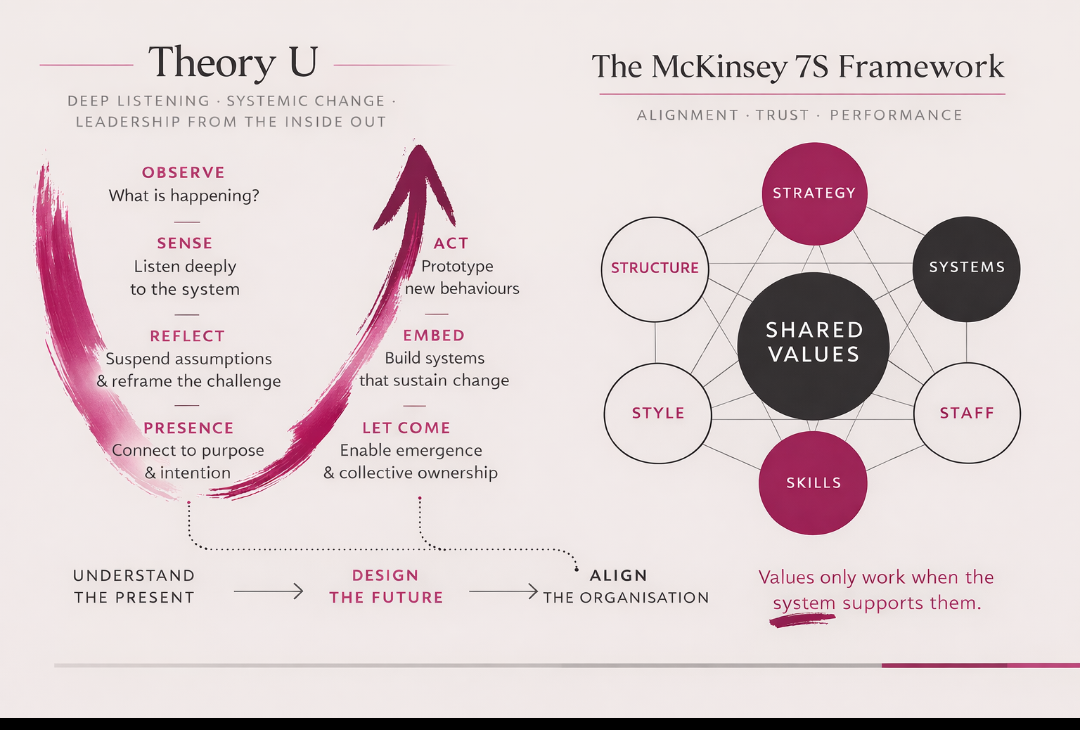
One way to understand this comes from the McKinsey 7S framework.
It describes organisations as a system made up of seven connected elements.
Three structural ones:
Strategy ,Structure ,Systems
And four human ones:
Shared values ,Leadership style ,Staff ,Skills
Shared values sit right in the middle.
But they cannot carry culture on their own.
If the other six parts of the system pull in a different direction, the values quickly lose their weight.
You see this play out in ordinary moments.
If performance systems reward speed but the values talk about care, people prioritise speed.
If collaboration is written down but teams are structured in silos, collaboration becomes difficult.
If leaders talk about openness but react badly to challenge, people quickly learn to stay quiet.
Culture does not follow what is written.
Culture follows what is reinforced.
Every meeting, decision ,promotion and every difficult conversation.

Those are the signals people notice.
What Clore and Theory U reminded me
During the Clore Leadership Programme I spent time exploring Theory U, developed by Otto Scharmer.
One idea from that work stayed with me.
Real change starts with understanding the system properly.
Not rushing to redesign language.
Not assuming leadership already knows the answer.
But slowing down and listening.
Theory U calls this sensing the system.
In practice that means leaders paying attention to how people actually experience the organisation.
Not what the strategy says.
But what the daily reality feels like.
Leaders need to notice:
where people feel proud
where frustration sits
where the gap between intent and reality starts to appear
Those signals are usually already there.
They just require space to hear them.

Only once that understanding exists can something new be built.
What tends to appear when organisations listen
When organisations genuinely listen to colleagues, a familiar pattern appears.
Most people believe in the purpose.
They care about the work.
They want the organisation to succeed.
What they struggle with is consistency.
Values exist on paper.
But they are harder to see in daily decisions.
A few themes often show up:
there are too many values
the language feels distant from everyday work
leadership behaviour sends mixed signals
Sometimes colleagues can quote the values.
But they cannot point to where they appear in the work.
That is usually when values start to feel like branding rather than guidance.
None of this usually comes from bad intent.
More often the systems around the organisation were never designed to reinforce the values.
So people default to what the system rewards.
Targets ,Deadlines ,Structures.
The behaviour that gets rewarded is the behaviour that sticks.
Turning values into something useful
If values are going to matter, they need to move from statements into practice.
In my experience three things help.
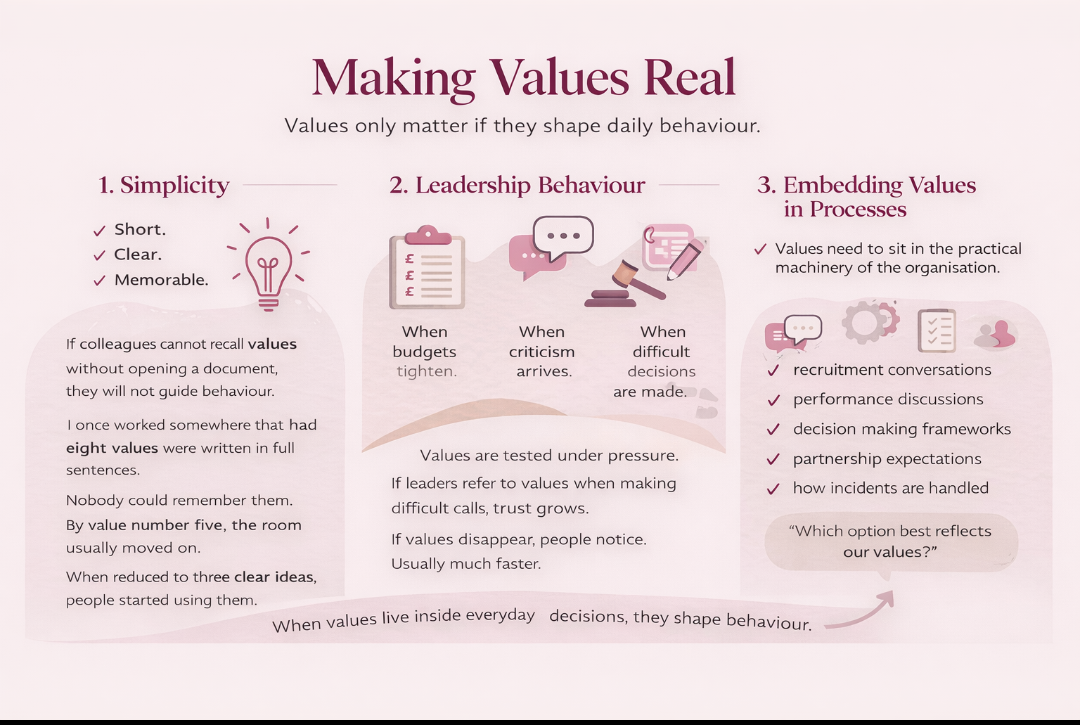
The boardroom test
Governance matters here as well.
Boards will endorse values.
But endorsement is only the starting point.
Trustees and non-executives can ask a few direct questions.
Are our decisions aligned with the values we claim?
Do they hold when pressure rises?
Where might they be tested next?
Those questions bring values into oversight.
They move from aspiration to accountability.
In the round …
For me the lesson is fairly simple.
Values are not about sounding impressive.
They help people recognise what good behaviour looks like.
They should help:
a colleague dealing with a difficult situation
a manager making a fair call
a board noticing when something feels out of line
If values cannot do that, they are not really values.
They are just words.
Often very nicely designed words.
The real aim is not to write better values.
It is to build organisations where people can see them in action.
On ordinary days and especially on the difficult ones.
Here’s to a bright future rooted in our rich past 🧔🏻♂️
#Leadership #OrganisationalCulture #CloreLeadership #TheoryU #PurposeAndPerformance #EvenKeel ✳️🙂
