Why good ideas are usually carried through one slice at a time
People rarely resist change itself
There is a strange tension inside most organisations.
People say they want change. They talk about innovation, fresh thinking and doing things differently. But the moment real change arrives in the room, something shifts. The atmosphere tightens. Questions appear almost instantly. Is this too much? Too risky? Too expensive? Will it alter the identity of the place? Will it create more pressure for teams already stretched thin?
I have seen this repeatedly across museums, hospitality businesses and public organisations. Often the idea itself is not the problem. The problem is the scale of it. Human beings struggle with large, sudden movements. Organisations are no different.
That is why the salami tactic matters.
The phrase itself sounds faintly ridiculous, but the principle behind it is deeply practical. Instead of trying to force through one huge transformation in a single moment, you move piece by piece. One slice at a time. A pilot before a rollout. A test before a restructure. A proof point before a strategy refresh.
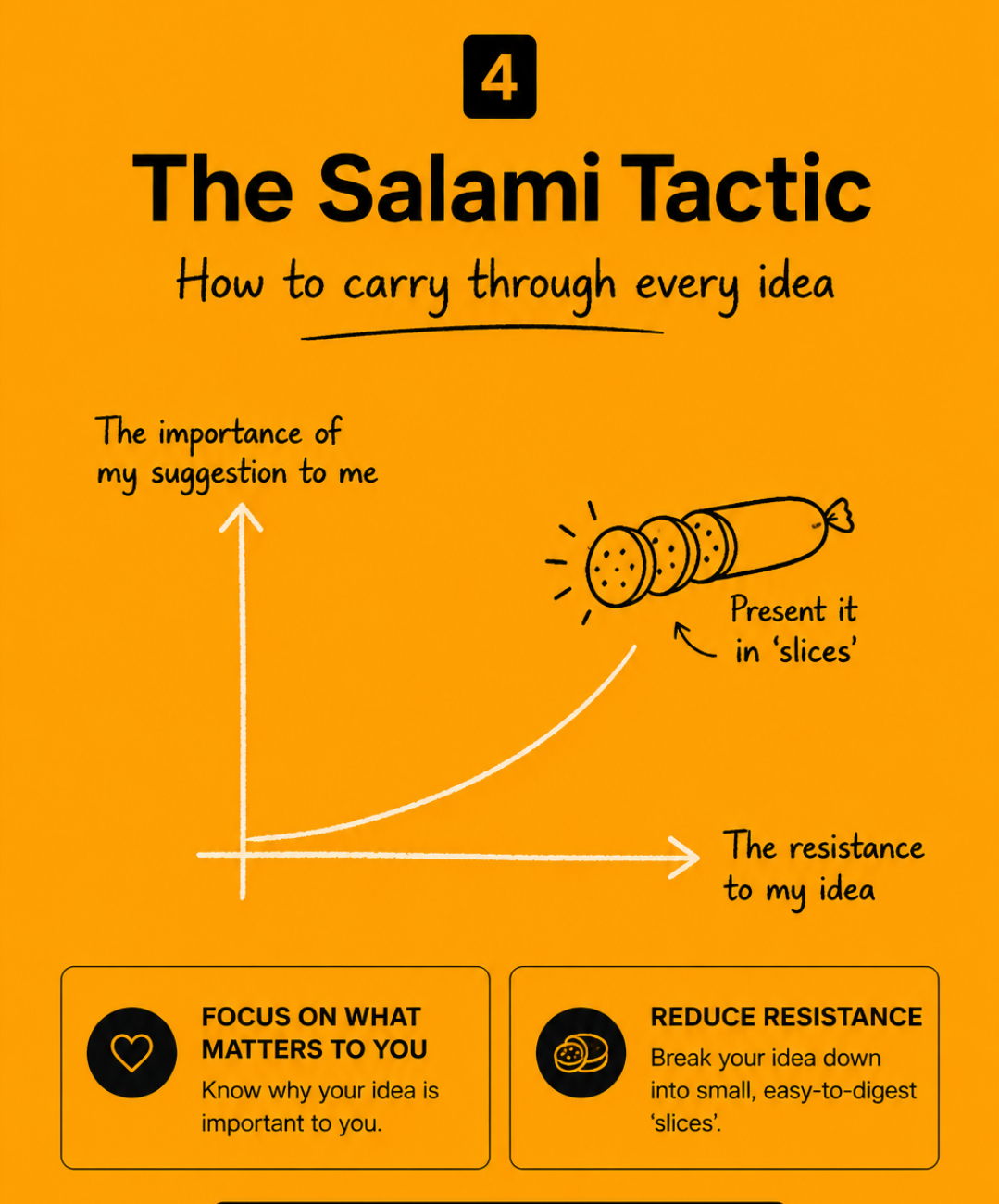
Done properly, it is not about manipulation. It is about understanding how people actually absorb change.
The danger of presenting the finished picture too early
The mistake many leaders make is presenting the finished picture too early. They walk into a meeting carrying the complete vision in their head. They can already see the future state. The new structure. The new operating model. The commercial opportunity. The cultural shift.
The organisation cannot see it yet.
That gap matters more than most leaders realise.
We like to imagine organisations make decisions rationally, but most decisions are emotional first and rational second. People instinctively assess how a proposal will affect their workload, identity, confidence or influence long before they assess the strategic merits of it. That is simply human nature.
I think this is particularly true in the cultural sector, where people often carry a deep emotional connection to mission and identity. A proposal that feels commercially sensible to one person can feel existential to another. You are not simply discussing operating models. You are discussing values, purpose and belonging.
Most resistance is emotional before it is strategic
That is why large-scale change often fails before it has even properly begun. Not because the idea is wrong, but because the organisation has not emotionally travelled far enough to accept it.
The strongest operators I have worked with understand this instinctively. They rarely announce revolutions. Instead, they create movement. They introduce one successful evening event rather than redesigning the entire public programme. They test a new retail concept before rebuilding the trading strategy. They improve one part of the visitor journey first, allowing people to experience tangible progress before discussing broader transformation.
Momentum matters enormously.
Once people see something working, the emotional resistance starts to soften. Conversations change tone. The question is no longer “why are we doing this?” but “how far could this go?” That is a completely different organisational mindset.
Evidence changes the emotional temperature
I have watched this happen countless times with commercial activity in museums and heritage settings. Initially there is anxiety that income generation might somehow compromise integrity. Then a well-run event attracts new audiences. Secondary spend improves. Visitor feedback is strong. Teams begin to enjoy the atmosphere and energy around it. Slowly, confidence grows.
Nothing changed overnight.
What changed was belief.
This is the part many leaders struggle with because patience is uncomfortable when the need for change feels urgent. Good leaders often see the destination long before everyone else does. That can create frustration. You start wondering why people cannot see what feels obvious. Why the organisation is moving slowly when the case for action appears overwhelming.
But leadership is not simply about spotting the answer first. It is about carrying people towards it without breaking trust along the way.
Organisations remember pain
That takes emotional intelligence as much as strategic thinking.
Some organisations have long memories of failed projects, poor restructures or unstable leadership. They have learned caution through experience. In those environments, even sensible ideas can feel threatening because people associate change with exhaustion or disappointment. Leaders ignore that emotional history at their peril.
The salami tactic works because it respects organisational psychology rather than fighting against it. It accepts that confidence is built gradually.

One successful step creates permission for the next. A team that survives one change successfully becomes more capable of accepting another.
Sequencing matters more than theatre
There is an important caveat, though. This approach only works if people trust your intent. If incremental change becomes covert manoeuvring, organisations quickly become cynical. Staff are remarkably good at sensing when they are being managed around rather than brought along. The strongest leaders are honest about direction. They simply understand sequencing.
They say: this is where we need to get to, but we are going to move steadily and learn as we go.
That creates calm.
And calm is underrated in leadership.
Particularly now, when many workplaces are carrying fatigue, financial pressure and constant uncertainty. Dramatic leadership may look impressive from a distance, but in practice it often creates anxiety rather than progress. Quiet competence usually travels further.
Real change is usually quieter than people expect
The older I get, the more I think successful leadership is about helping people feel capable of movement again. Not overwhelming them with grand language or forcing pace for the sake of appearances. Real change is usually less theatrical than we imagine.
It arrives through accumulated proof. One improvement. One successful test. One conversation. One slice at a time.
Then eventually people look around and realise the organisation has changed far more than they ever thought possible.
Not through one dramatic moment.
Through steady momentum.
